Every portfolio manager will have to deal with crypto

11 November 2025
About a year ago, I stood before a large group of institutional investment professionals to discuss the rise and adoption of crypto. I explained how clear regulation had opened the door to bitcoin ETFs and how ether was likely to follow a similar path.
I pointed to the rapid emergence of stablecoins, digital dollars on the blockchain that in my view represent the first truly successful form of tokenisation. I also highlighted how major asset managers had already begun putting their first money market funds on-chain. My message then was simple: these developments are just the beginning. Sooner or later, other traditional assets would find their way to the blockchain as well.
The pace of change since then has been extraordinary. To me, it’s confirmation that crypto and traditional finance are converging at an accelerating rate. Where we stood at the foot of the inflection point a year ago, we now find ourselves right in the middle of it. I believe we are at the start of a phase of exponential growth.
2025: A year of robust regulation
Exponential growth requires a solid regulatory foundation. Only when confidence grows will institutional capital truly enter the market. This year, the United States introduced sweeping new crypto legislation. President Trump signed two executive orders.
One of them, Strengthening American Leadership in Digital Financial Technology, reversed Biden’s earlier, more cautious stance. It banned central bank digital currencies (CBDCs), promoted dollar-backed stablecoins, and laid the groundwork for a federal regulatory framework.
That framework took shape with the Genius Act, passed in July 2025, which defines the conditions under which stablecoins can be issued in the United States. The Clarity Act aims to clarify which crypto assets fall under SEC supervision and which under the CFTC. The Anti-CBDC Act prohibits the Federal Reserve from issuing a digital dollar, though it still awaits final approval from Congress.
Another notable step followed in August: an executive order allowing the inclusion of crypto in 401(k) retirement plans.
In Europe, the signals are equally positive. The Markets in Crypto Assets Regulation (MiCAR) came into effect at the end of 2024, harmonising the rules for issuers and service providers. Its goal is to create greater legal certainty, investor protection, market integrity, and financial stability.
For investors on both sides of the Atlantic, these developments create a more transparent and secure crypto landscape. Service providers benefit too. After years of hesitation caused by regulatory uncertainty, the brakes are finally off. With clear rules in place, innovation can truly accelerate.
With that foundation established, attention is now shifting to the next phase: adoption and real-world application.
Adoption accelerating? Show me
The launch of U.S. bitcoin ETFs stole the spotlight, while interest in similar ether products lagged for a while. That changed when BitMine Immersion Technologies entered the stage. Under the leadership of Tom Lee, the U.S. firm has been building a sizable ether treasury, a strategy reminiscent of Michael Saylor’s MicroStrategy with bitcoin.
According to Lee, “Ethereum is the internet of finance,” and Wall Street is starting to realise it. Another key point is that ether is a productive asset, an investment that generates cash flow. That resonates strongly with traditional investors. The price of ether doubled over the past year, while total inflows into Ethereum ETFs surged from $2 billion to more than $18 billion.
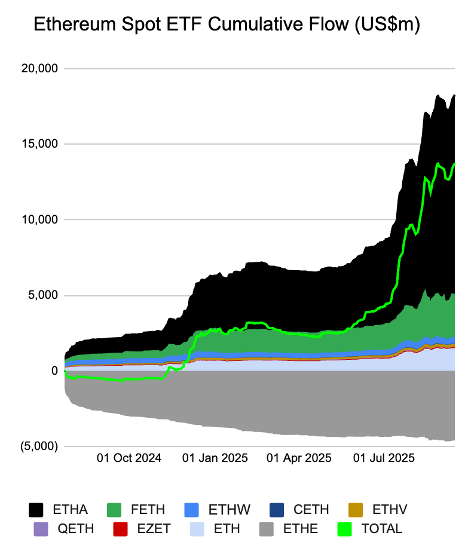
Figure 1: Strong inflows into Ethereum spot ETFs, from $2 billion to over $18 billion in 2025.
So yes, investors are enthusiastic. But speculation and adoption are not the same thing, are they?
True, yet I do see a clear connection. Every tokenisation initiative by major institutions attracts significant media attention. Where private blockchains once dominated, we’re now seeing a decisive shift toward public ones. That visibility brings more investors into the underlying technology.
The result is a cycle of rising prices and growing attention, which in turn creates FOMO among those still on the sidelines. Back in 2017, we were still searching for use cases. Today, they are emerging everywhere in the form of tokenised real-world assets.
The real adoption story
Look at stablecoins, and you’ll find the answer. They’ve existed since 2014, but real traction began when Tether launched USDT on Ethereum. Since then, stablecoins have become an essential part of the market. Today, their total value stands at nearly $300 billion, and growth shows no sign of slowing.
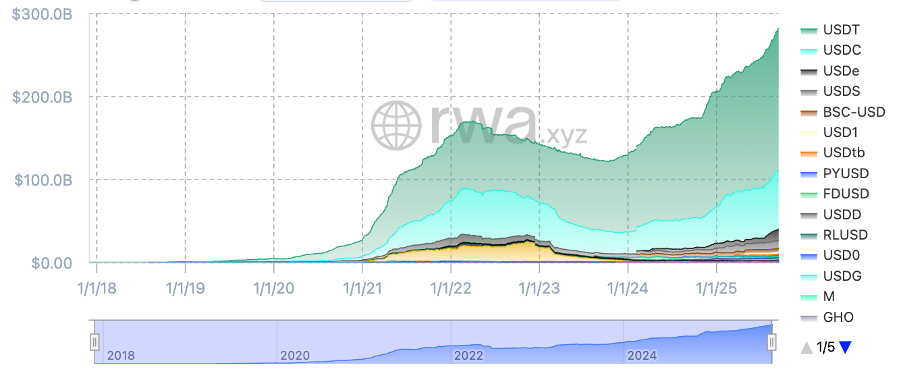
Figure 2: The total market value of stablecoins is approaching $300 billion, with USDT and USDC remaining dominant.
Stablecoins and tokenisation more broadly have surged over the past five years. But it doesn’t stop there. Money market funds, bonds, private credit, and even equities are now appearing on-chain.
To some, this looked like years of disconnected experiments, attempts to make blockchain relevant. I see it differently. This was the early stage of the classic “hockey stick” growth curve: a slow start where the market learns what works, followed by a sharp inflection point.
According to Bloomberg, BlackRock is now actively working to bring its ETFs on-chain. Nasdaq has filed to tokenise equities and exchange-traded products (ETPs), and Ondo recently launched tokenised trading for more than 100 U.S. stocks and ETFs, reaching $260 million in value within a month.
The speed and scale of these announcements from major institutions leave little doubt in my mind. We’ve passed the inflection point, and the years ahead will bring unrestrained growth.
Ethereum as the bridge between traditional and digital finance
The lines between crypto and traditional markets are blurring. Traditional assets are increasingly represented as tokens on the blockchain, while crypto assets are becoming accessible through ETFs and listed securities.
Where these worlds once existed in parallel, they are now merging rapidly. Zoom in on the underlying infrastructure, and you’ll find Ethereum at the centre of it all.
If Ethereum maintains its leadership in this transition, Tom Lee may well be proven right, and I might just win a bet I made back in 2017 with a former colleague:
“Every portfolio manager, fan or not, will have to deal with crypto, because it is becoming the infrastructure through which all traditional financial products will eventually flow.”
Our website uses cookies
We use cookies to personalize content and advertisements, to offer social media features and to analyze our website’s traffic. We’ll also share information about your usage with our partners for social media, advertising and analysis. These partners can combine this data with data you’ve already provided to them, or that they’ve collected based on your use of their services.