Crypto market under pressure due to geopolitical tensions

Last weekend, the price of Bitcoin experienced two sharp declines, falling well below $61,000. The unrest between Iran and Israel is cited as the cause. With the halving approaching, geopolitical tensions remain high. What does this mean for the market? That, and more, you'll read in this Weekly!
This weekly in brief:
- Market: The cryptocurrency market has been moving sideways for seven weeks, with Bitcoin trading between $60,000 and $74,000. Last weekend, we saw a rapid decline within this price range.
- News: The halving is coming, likely on the night from Friday to Saturday. At that time, a new token protocol will also come into effect: Runes. Expect (strongly) increased transaction costs in the initial period after the halving.
- Behind the scenes: Last Friday, our Senior Compliance Officer Mauro Lorenzo Halve was a speaker at the European Conference of Global Sanctions and Export Controls. He had the opportunity to discuss how Amdax keeps the crypto market clean of sanctioned entities.
Market update
Last weekend, the cryptocurrency market took a significant hit. The price dropped in two steps, about 12%, from $71,000 to around $62,000. The lowest point was seen on Saturday evening with a brief drop to $60,800, nearly equal to the previous lowest point of this correction.
The downward slide began on Friday afternoon when Bitcoin lost 5% in a short time, along with stocks and gold. The market barely had time to catch its breath because a second decline followed on Saturday evening. At that moment, all other financial markets were closed.
Overall, there was a difference of 15% between the highest point on Friday and the lowest point on Sunday. This aligns well with the current price range, roughly between $60,000 and $74,000. We traversed that entire range from top to bottom in just one weekend. And although it may have felt turbulent and exciting, in the long term, there's actually (still) nothing to worry about.
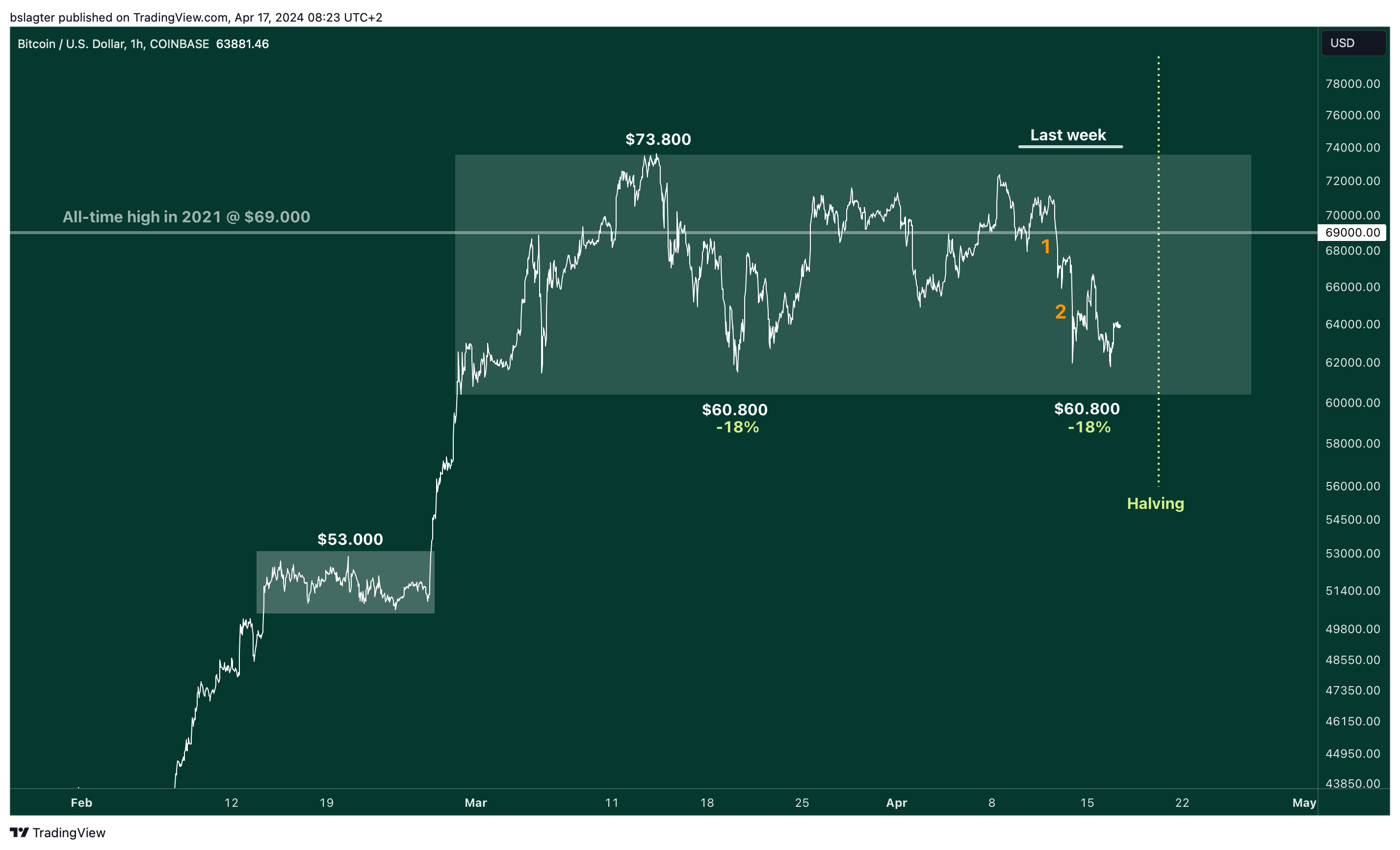
Some analysts attributed the price declines to the attack by Iran on Israel overnight from Saturday to Sunday. There's something to be said for that when you look at the timing. Another argument is that smaller altcoins dropped faster than Bitcoin and Ether, indicating that investors were reducing their exposure to risky assets.
It's plausible that the headlines about the attack boosted the market. But even without this catalyst, the decline would likely have occurred eventually. Two other forces are also at play.
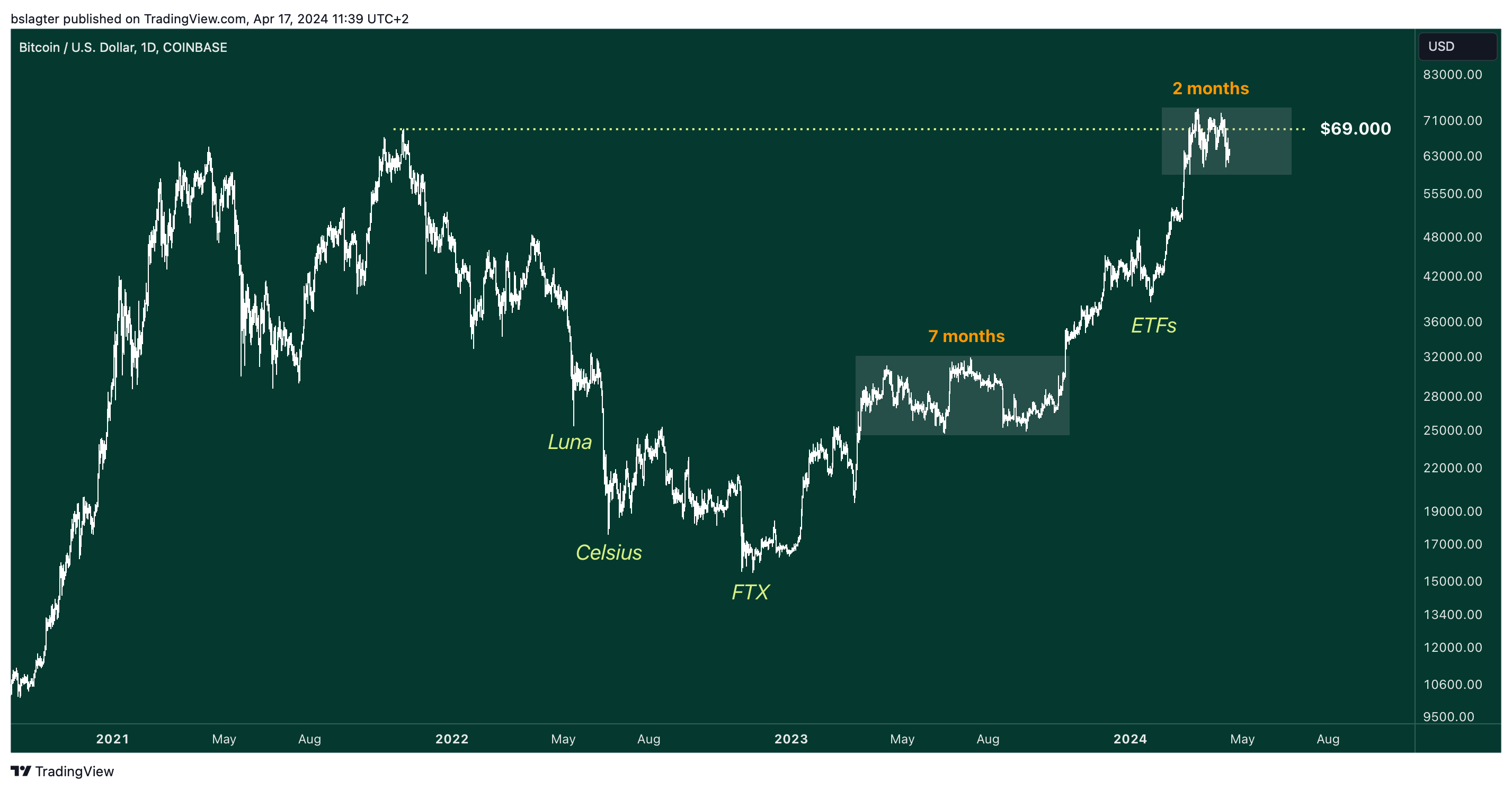
Firstly, the cryptocurrency market is in a correction after six months of significant growth. The price of Bitcoin has nearly tripled, and some altcoins have made even larger leaps. It's quite normal and even healthy for a pause to follow such a rise. During this period, sentiment also cools down, providing fertile ground for a panic reaction to negative news.
Additionally, in recent weeks, the outlook on the macroeconomic front has deteriorated. At the beginning of the year, the market still firmly believed in a soft landing, where inflation would decrease to 2% without the economy entering a recession. The central bank would accompany this landing with a series of interest rate cuts.
That image is now shaky. Inflation seems to be not declining further and remains around 3%, while the economy is picking up. There is hardly any talk of interest rate cuts anymore, and bond yields and the dollar exchange rate are rising. All headwinds for financial markets.
A correction after six months of phenomenal growth, macroeconomic uncertainty, and geopolitical unrest — a reasonable explanation for the turbulence in financial markets and the weak performance of the cryptocurrency market.
Consolidation around the 2021 all-time high could last for a few more weeks. In an extreme case, even a few more months, think back to March to October 2023 when the price was trapped between $25,000 and $32,000 for half a year. But most data indicate that this bull market is not over yet, and when the time is right, we will continue to move upwards.
News Overview
The halving is coming soon, likely early in the night from Friday to Saturday. This time, not only will the reward miners receive for their work be halved. It's also the moment when a new token protocol launches: Runes.
You might be thinking: Runes? No worries, we'll tell you right away what world lies behind it.
Since early 2023, it has been possible to record NFTs on Bitcoin. Soon after the introduction of these so-called Inscriptions, creatives came up with new applications for them. This led to the BRC-20 protocol, a way to issue new tokens using Bitcoin NFTs. A nice experiment, and some BRC-20 tokens saw lively trading. However, they turned out to be impractical, inefficient, and error-prone in practice.
And so, a successor was devised. It comes from none other than Inscriptions creator Casey Rodarmor and is named Runes. This new token protocol cleverly utilizes Bitcoin's underlying technology and bypasses the use of Inscriptions. The result is a more efficient and robust protocol, with fewer dependencies. When will the protocol come into operation? Directly at the upcoming halving.
Anticipation for this launch has sparked considerable excitement among speculators. Market analysts expect them to flock to Bitcoin en masse to try their luck there. So far, it seems they're right: last week, Bitcoin NFTs alone accounted for a higher sales volume than the entire top 10 combined!
💡Crypto savings plan
Avoid buying at a high price at one point and spread your purchases over a longer period. This investment strategy is known as Dollar Cost Averaging (DCA). This spreads the risk and gives you peace of mind.
Want to buy crypto assets periodically and automatically? With the crypto savings plan, that's easy to set up. All you have to do is make sure there's enough balance in your account.

Other news:
- Solution to transaction issues on the Solana network within reach? The meme coin craze has reached the network's limits, causing users to experience problems both at the network and application levels. Solana developers are testing a solution for the resulting congestion on a test network.
- Bitcoin and Ether funds coming soon to Hong Kong? Monday morning, various asset managers announced shortly after the market opened that they had permission to launch spot bitcoin and ether funds. Some analysts expect these ETFs to be not only interesting for Hong Kong but also for investors active from within mainland China.
- Ethereum now has over 1 million validators. A total of 32.3 million ETH is locked up for staking, worth more than $114 billion. Another 15.5 million ETH is locked up in DeFi protocols, 7 percent more than at the beginning of April. Increased activity on Base – Coinbase's blockchain platform – is a significant driver of this.
Deepen
Have you become curious and want to know more about Runes? Then listen to the latest episode of Satoshi Radio. In it you will hear from host Bart Mol more about the origin of this token protocol, how it differs from other standards, what is done with it and in what way - even if you don't do anything with Runes - you have to deal with it as a bitcoin user. The Satoshi Radio podcast is Dutch spoken.
Behind the scenes
Last Friday, Senior Compliance Officer Mauro Lorenzo Halve was a speaker at the European Conference of Global Sanctions and Export Controls. He had the opportunity to give the audience an insight into how service providers like Amdax keep the crypto market clean of sanctioned entities, together with Bitvavo, Nevo, and Compliance Champs. The topics discussed included how Chainalysis works, how much crypto is actually used to circumvent sanctions, and whether sanctioning crypto addresses is effective or not!

Related articles
View all updates
Bitcoin fell along with tech stocks last week and hit its lowest level since August on Sunday. When stocks bounced back on Monday, bitcoin stayed put. In Washington, prediction markets and crypto companies linked to the Trump family are coming under fire. And on Thursday, the Dutch House of Representatives votes on box 3, the Dutch tax on wealth and investments, where crypto remains an exception.


6.3 billion dollars disappeared from Binance last week, the largest crypto theft on record. Bitcoin slid along with tech stocks to its lowest level since mid-September. The same day, the owner of the NYSE chose Hyperliquid’s technology for a new market. And the Dutch Council of State wants the new Box 3 tax postponed until 2030.


Bitcoin slipped back to 80,000 dollars with tech stocks over the past week, while gold fell below 4,000 dollars. The Fed decides on rates today. In the US, the first final stablecoin rules are in place, and DNB has mapped Dutch household crypto holdings for the first time.
Stay on top of the market and subscribe
Receive Amdax Weekly in your mailbox every Wednesday.
